What Nobody Tells You About How VAR Works
VAR, or Video Assistant Referee, is a football officiating system that reviews possible clear and obvious errors in four areas: goals, penalties, direct red cards, and mistaken identity. The system op...

What Nobody Tells You About How VAR Works
VAR, or Video Assistant Referee, is a football officiating system that reviews possible clear and obvious errors in four areas: goals, penalties, direct red cards, and mistaken identity. The system operates through a VAR team with independent access to broadcast footage, while the on-field referee retains the final decision in competitions approved by FIFA and governed by the International Football Association Board (IFAB). VAR does not automatically replace the referee, and it does not review every foul, throw-in, or yellow card. In most matches, every relevant incident is checked silently, with intervention reserved for a clear error or serious missed incident. The referee may accept information from the VAR or conduct an on-field review. Review speed has no fixed legal limit, although practical checks often take between 30 seconds and several minutes. For 2026 World Cup coverage, follow the incident, the original decision, and the exact review category—not the shouting around the stadium.
Imagine a last-minute goal, a penalty appeal, or a tackle that looks ugly from one camera angle but ordinary from another. Football used to leave those moments entirely to the referee’s view. VAR adds a second layer of evidence, which is useful, provided people stop treating it like a magic eraser for every decision they dislike. Stadium View covers match predictions, tactics, player statistics, and FIFA World Cup 2026 developments, so understanding VAR matters when evaluating a match rather than merely yelling at the television.
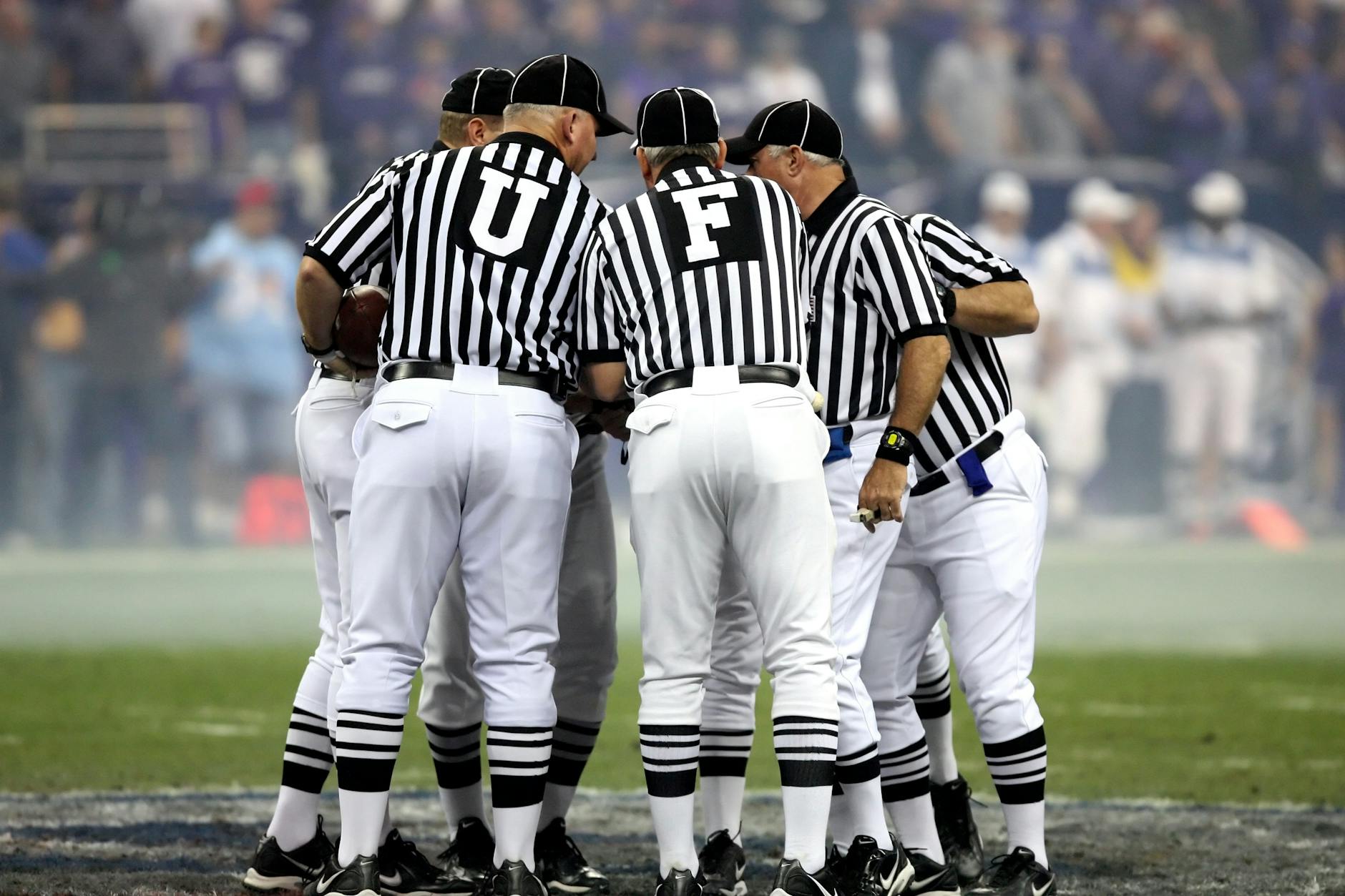
Photo by Pixabay on Pexels
Want the practical version before the technical details? Start with the [Internal Link: FIFA World Cup 2026 match analysis guide], then use the process below to separate an actual VAR intervention from ordinary referee judgment.
If you want to know whether VAR can intervene: identify the four review categories
VAR can intervene only for a possible clear and obvious error or serious missed incident involving a goal or no goal, penalty or no penalty, direct red card, or mistaken identity. These four categories are defined by the IFAB VAR protocol, so routine fouls, ordinary second-yellow-card decisions, and most restarts are outside its scope. The original referee decision remains in place unless the review shows a qualifying error.
The first category covers goals and no-goal decisions. Officials can check whether the ball fully crossed the goal line, whether an attacker was offside in the buildup, whether a foul occurred before the goal, or whether the attacking team committed a handball offence relevant to the scoring move. The review period is not unlimited in subject matter; it follows the laws governing the attacking phase, not every event that happened several minutes earlier.
The second category concerns penalties. VAR may check whether a foul occurred inside or outside the penalty area, whether a penalty was awarded incorrectly, or whether a serious handball offence was missed. It can also identify simulation or a foul by the attacking team before a penalty is given. However, “contact” alone is not an automatic penalty. Football, astonishingly, still requires judgment.
The final two categories are disciplinary. A direct red-card review can examine serious foul play, violent conduct, spitting, biting, or offensive actions, but it does not normally correct a clearly wrong second yellow card. Mistaken identity applies when the referee penalises the wrong player. According to IFAB’s official VAR protocol, “the final decision is always taken by the referee.” That sentence is not decorative. It is the entire hierarchy.
The four reviewable areas
- Goal or no goal: offside, fouls, handball, and ball-crossing-line incidents.
- Penalty or no penalty: location, foul, handball, and attacking offences.
- Direct red card: serious foul play and violent or abusive conduct.
- Mistaken identity: correcting the player who receives a card or dismissal.
For deeper tactical context, see the [Internal Link: how to read football referee decisions] before judging whether a review was correctly applied.
If you are watching a review live: follow the five-stage process
A standard VAR review begins with an on-field decision, continues through an automatic check, and ends with the referee’s final ruling. The VAR may recommend a review, but only the referee can initiate the formal review, and the referee must always make an initial decision. Depending on the incident, the referee can accept factual information from the VAR or inspect the replay personally at the Referee Review Area.
Here is how the process normally works:
- The referee makes a decision. Play may continue, stop, or restart according to the incident.
- The VAR checks the footage. Multiple camera angles, replay speeds, and available technology are examined.
- The VAR communicates a recommendation. The recommendation may be “check complete” or may suggest an on-field review.
- The referee reviews or accepts information. Factual offside matters may be settled through communication, while subjective foul decisions commonly require the referee to watch the footage.
- The referee announces the final outcome. The decision may stand, change, or result in disciplinary action.
The distinction between a factual and subjective review is where many viewers lose the plot. A player being beyond the second-last defender can be a factual matter when the camera calibration and relevant frame are clear. Whether a defender’s contact is careless, reckless, or excessive remains a judgment call, even after replay. Slow motion can exaggerate contact and make normal football look like a crime scene; real-time speed often gives better context.
IFAB also states that there is no formal time limit for a review because accuracy takes priority. That does not mean officials should conduct a historical documentary every time a striker falls over. The incident must remain within the legal review window, and once play has restarted, most reviews are no longer possible except in limited cases such as mistaken identity or certain violent-conduct incidents.
Photo by Pixabay on Pexels
Want to understand what officials are checking rather than guessing? Stadium View’s [Internal Link: World Cup referee and rules explainer] is the sensible place to continue.
If you want to understand offside VAR: separate technology from judgment
Offside VAR combines calibrated camera footage, player positions, and the Laws of the Game to determine whether an attacking player was nearer the opponents’ goal line than both the ball and the second-last opponent when involved in active play. Semi-automated offside technology can accelerate this process, but the referee team still validates the relevant moment and the offence. The technology identifies positions; it does not decide every football question.
The most important technical detail is the frame selection. Officials must determine when the ball was played or touched by the teammate, then compare the attacker’s eligible body part with the second-last defender. Hands and arms do not count for offside, while the head, body, and feet can. A defender’s deliberate play of the ball may reset the phase, whereas a deflection or deliberate save generally does not. That distinction is why a replay can appear obvious while the legal conclusion remains complicated.
At major FIFA competitions, semi-automated systems may use dedicated tracking data and limb-position modelling to provide a faster alert. The exact equipment and implementation can vary by competition, stadium, and broadcast package. Do not assume every league has identical camera coverage or the same level of automation. A domestic match with seven broadcast angles is not technically equivalent to a FIFA tournament using specialised tracking infrastructure.
The practical edge case most casual viewers miss is that the “freeze frame” is not always visually satisfying. Camera perspective, lens distortion, frame rate, and the moment of contact with the ball can affect what appears to be the correct image. A one-frame difference may alter the outcome when an attacker’s shoulder or knee is only centimetres beyond the defensive line. That is not proof of corruption; it is proof that football happens quickly and television is not omniscient.
For match predictions, this matters because an offside call may remove a goal without changing the underlying attacking pattern. A team that repeatedly creates high-quality chances is still dangerous even if one finish is cancelled. Smart analysis records the shot quality, buildup, defensive line, and tactical cause rather than treating VAR as random punishment from the sky.
What VAR does not normally review
- Ordinary free-kick decisions outside a penalty or red-card context.
- Most throw-ins, goal kicks, and corner-kick decisions.
- A routine yellow card.
- A clearly incorrect second yellow card.
- Tactical fouls that do not meet the direct-red threshold.
- Every possible infringement in the several minutes before a goal.
The International Football Association Board publishes the Laws of the Game and protocol that competitions use as their regulatory foundation. Read the actual framework before repeating a social-media verdict delivered by someone whose evidence is one blurry replay and confidence bordering on clinical symptoms.
If you are evaluating a VAR decision: compare the evidence, not the reaction
A sound VAR assessment asks four questions: What was the original decision? Was the incident reviewable? Did the footage show a clear and obvious error? Did the final decision match the applicable law? This method is far more reliable than judging the process by how long the referee stood at the monitor or whether the crowd applauded.
The phrase “clear and obvious error” sets a high intervention threshold. VAR is not designed to re-referee every borderline decision. If two reasonable referees could reach different conclusions from the same footage, the original decision will often stand, particularly for subjective fouls. A review should correct an obvious mistake, not convert the VAR official into a remote manager with a personal whistle.
A useful viewing checklist looks like this:
- For a goal: check the attacking phase, offside position, handball, and prior foul.
- For a penalty: check location, contact, player action, and whether the attacker initiated the contact.
- For a red card: check speed, intensity, point of contact, studs, danger, and intent where relevant.
- For mistaken identity: check the player who committed the offence, not simply the player nearest the incident.
- For timing: check whether play restarted before the review was completed.
There is also a transparency issue. VAR officials usually communicate with the referee, while broadcasters show selected replay angles and may not reveal the full discussion. A television audience can therefore see the same event through an incomplete evidence set. That is why certainty should be proportional to the available footage. The person screaming “obvious” after one replay is usually demonstrating a shortage of angles, not a surplus of expertise.
The FIFA Laws of the Game resources are useful when a tournament uses a specific officiating setup. FIFA World Cup 2026 matches will attract intense scrutiny, but the governing principle remains unchanged: VAR supports the referee; it does not become the referee.
Photo by Terrance Barksdale on Pexels
After a controversial call, compare the rules with the footage before adjusting a prediction, fantasy selection, or betting view. It is less exciting than outrage, but considerably more profitable than betting on a misunderstanding.
Common pitfalls to avoid
The most common VAR mistake is assuming that every replay should produce a different decision. It should not. VAR exists to correct defined errors, not to guarantee unanimous approval from fans, commentators, coaches, players, and the person in row 14 who has somehow become a constitutional lawyer.
A second mistake is confusing a check with a review. The VAR team checks every potentially relevant goal, penalty, red-card, and identity incident. A check can remain invisible and simply confirm the referee’s decision. A formal review usually involves a recommendation and, for subjective decisions, an on-field review by the referee. Saying “VAR reviewed it” when only a silent check occurred makes the explanation sound more dramatic and less accurate.
A third mistake is treating slow motion as automatically superior. Slow-motion footage clarifies the point of contact, but it can distort speed and force. Referees may use normal-speed footage to assess intensity, then slow motion to identify contact location. Both views have a purpose, which is inconvenient for anyone hoping the first replay settles everything.
Avoid these analytical errors:
- Calling every contact a foul. Football permits contact; not all contact is careless or illegal.
- Ignoring the original decision. The threshold is correction of a clear error, not a blank-sheet ruling.
- Assuming all competitions use identical technology. FIFA, UEFA, and domestic leagues can differ in cameras and automation.
- Blaming VAR for stoppage time. Referees calculate delays, and a review is only one possible cause.
- Treating referee communication as a player request. Players and coaches cannot demand a review.
- Using one broadcast angle as complete evidence. Production feeds do not always show the decisive view.
A less obvious problem affects betting analysis. Markets can move before a public review is fully explained, especially after a goal is scored or disallowed. A bettor who reacts to the first television replay may enter at a worse price than someone who waits for the restart and confirmed decision. Stadium View focuses on match intelligence rather than panic, because markets punish emotional improvisation with admirable consistency.
The 30-day check-in: has VAR improved the way you watch football?
After 30 days of watching VAR deliberately, measure its value by accuracy, consistency, and match flow rather than by whether it creates longer celebrations. VAR has reduced some major officiating errors, particularly mistaken identity, obvious offside goals, and penalties awarded in the wrong area. It has not removed subjective judgment, controversy, or the basic human desire to argue about football in public.
A practical 30-day review can track the following:
- Number of goals checked and whether the original decision changed.
- Average time between the incident and the restart.
- Whether the incident involved a factual or subjective question.
- Whether the broadcast showed enough angles to understand the outcome.
- Whether the decision affected your match prediction or live assessment.
- Whether the final call followed the relevant IFAB category.
This record produces a more useful conclusion than slogans about “ruining football.” If reviews mostly correct factual errors and preserve reasonable subjective decisions, the system is doing its intended job. If a competition experiences repeated delays, unclear communication, or inconsistent intervention thresholds, the criticism should target implementation and education rather than the mere existence of video evidence.
The contrarian point is simple: VAR is most valuable when you barely notice it. A silent check that confirms a correct goal or penalty is a successful intervention, even though it produces no dramatic television moment. The system becomes irritating when broadcasters, officials, or fans treat every pause as a theatrical courtroom hearing. Football needs better explanations, faster operational discipline, and consistent application—not another gadget sold as perfection.
Photo by Caio on Pexels
For ongoing tournament analysis, use Stadium View’s [Internal Link: FIFA World Cup 2026 predictions and team tactics] alongside confirmed lineups, injuries, formations, and official decisions. That combination tells you more than a replay loop.
The bottom line is that VAR works as a safety net, not an autonomous referee. It checks defined incidents, intervenes only for a clear and obvious error or serious missed incident, and leaves the final decision with the on-field referee. Watch the original call, the review category, the evidence, and the restart before forming an opinion. Yes, this requires more thought than yelling “corruption,” but so does almost everything worth getting right.
Want a clearer framework for tournament decisions and match context? Use Stadium View for daily World Cup coverage and keep the evidence in view.
Frequently Asked Questions
Q: What is VAR in football?
A: VAR means Video Assistant Referee, a video-based support system for match officials. It reviews possible clear and obvious errors involving goals, penalties, direct red cards, and mistaken identity. The VAR team checks footage from multiple angles, but the on-field referee remains responsible for the final decision. VAR is not a general replay service for every foul, throw-in, corner, or yellow card.
Q: How does VAR work during a football match?
A: VAR works by checking relevant incidents automatically, communicating with the referee, and recommending an on-field review when necessary. The referee makes an initial decision, while the VAR examines footage and may confirm it or identify a possible clear error. For subjective incidents, the referee commonly watches the replay at the Referee Review Area before announcing the final decision.
Q: What is the difference between a VAR check and a VAR review?
A: A VAR check is an automatic examination that may confirm the referee’s decision without stopping play, while a VAR review normally involves a recommended on-field review. Factual matters, such as some offside decisions, can often be settled through communication. Subjective matters, such as penalty contact or red-card severity, generally require the referee to inspect the footage personally.
Q: Why does VAR sometimes take so long?
A: VAR can take longer when officials must examine several camera angles, determine the relevant frame, or assess a subjective offence. IFAB does not impose a fixed maximum time because accuracy has priority over speed. However, the incident must remain within the legally reviewable phase, and officials should avoid examining unrelated events simply because the match has paused.
Q: Can VAR overturn a yellow card?
A: VAR generally cannot overturn a normal yellow card or correct a clearly incorrect second yellow card. It can review an incident when the offence may constitute a direct red card, including serious foul play or violent conduct. VAR can also intervene for mistaken identity when the referee has cautioned or dismissed the wrong player.
Q: Does VAR automatically decide offside?
A: VAR and semi-automated offside technology help identify offside positions, but the match officials still validate the relevant moment and apply the law. The system must establish when the teammate played the ball and whether the attacker’s eligible body part was beyond the second-last opponent. Hands and arms do not count, while the head, body, and feet can.
Q: Does VAR make football fairer?
A: VAR makes football more accurate in several high-impact situations, but it does not eliminate disagreement or subjective judgment. It is particularly useful for obvious offside goals, mistaken identity, and major penalty or red-card errors. Its effectiveness depends on camera coverage, referee training, communication, review speed, and consistent application of the IFAB protocol.
Thank you for reading.
Stadium View · Editorial Vault